Five Things I Like

August 30, 2005

If this is Tuesday, it must be time for Five Things I Like.

1. My Current Spam Filtering.
The lengths I’m going to in order to avoid dealing with spam remind me of the advice my Dad gave me on avoiding teen pregnancy:

• Put the condom on before you leave on a date.
• Make sure your date is on the pill,
• And never, ever, have sex.

Dad would appreciate my current precautions. Loc’s running spam filtering on the mail server, which is doing a lot to catch the first layer. Office 2003’s version of Outlook filters out a good slice of junk, and I continue to run SpamBayes which catches the stuff the first two didn’t. What I like is that, regardless of how ridiculous it seems, it works.

2. Technology Leapfroging.
New Zealand is going to an all VoIP phone system. Sitting back watching the other guys can pay off - the entire country will be VoIPed by 2012, according to Telecom. What I like is when a little country leapfrogs the rest of us.

3. My VoIP Phone.
I know there are free alternatives, but for business purposes, Vonage Canada has been the right answer for me. What I like is the web interface to every feature, from call forwarding to being able to retrieve mp3’s of my voice mail.

4. Don Tapscott’s Blog.
If you haven’t yet had a chance to see it, make sure you catch Don Tapscott’s blog at www.ageoftransparency.com/blog . Super insightful and an interesting take on corporate culture; you’re going to be naked, you better be buff. What I particularly like his retelling of a recent Toronto radio experience.

and…

5. Maybe It Just Feels Like 3 Weeks.
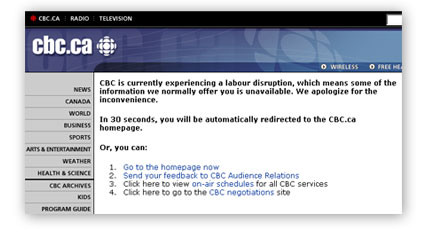
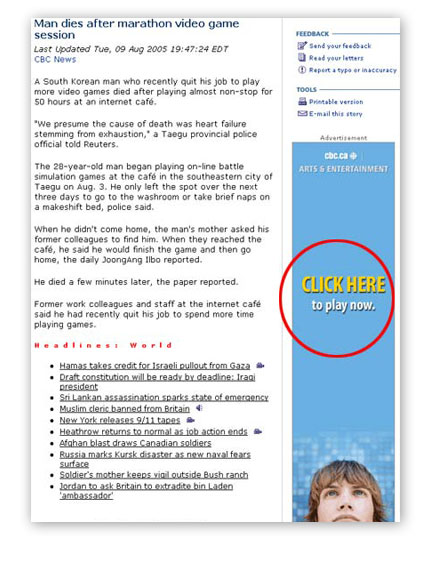
I promised I wasn’t going to say anything more about the CBC lockout until something happened. Today the two sides decided to get back to the table - which is good of course. This on the heels of an article in the Globe yesterday that cites a study showing Canadians aren’t too concerned about the lockout. What I like is the Globe’s math.


globe screen grab

Sphere: Related Content

Six Lessons for Broadcasters

August 29, 2005


shuffle

With everything that’s been said about podCasting, there are a bits on the trailing edge I’d like to pick up on.

Lesson Number One: There’s No Going Back.

The lessons for traditional radio are enormous. They’re the same lessons marketers everywhere are paying attention to, as are publishers and every middleman involved in the communications industry. They’re paying attention because models we’ve grown accustomed to are changing, and no one knows for sure just where they are taking us. What’s for certain is, once people change, they rarely go back to the old way of doing things.

Lesson Number Two: They’re On the Other End of the iPod.

I’ve been fascinated listening to broadcast executives justify their inability to understand what is going on, by challenging change with “but where’s the business model”. This is one of the great cries of the unconvinced. I heard it during the early days of the Internet in regards to web pages, and again when it came to online audio. Podcasting has no clear business models, yet. Better to ask, “Where’s the audience”. We know the answer; they’re on the other end of an iPod.

Lesson Number Three: You Can No Longer Fool Very Many People for Very Much of the Time.

Broadcasters need to break down what’s happening here. For years they’ve argued that they’re essential, based on a quality of service argument. They hire ‘real’ journalists, they have ’standards’ etc. On the basis of thier QOS argument, podcasting is a joke - the quality can be terrible and the reliability is spotty. But wait - why are there so many of them out there, and why are people clamoring to get them ?

One reason is they’re providing an array of content. A stunning array that grows daily. Broadcasters meanwhile, continue to rely on the same 200 songs or the same 20 topics for the call in show. When your public has been nurtured on a seemingly unlimited number of options, just a click away, it simply isn’t interested in highly limited choice. There’s a new universe out there, and we just aren’t buying the notion that Jack’s the only person with a handle on it.

Lesson Number Four: Give Me What I Want When I Want It or Get Out of the Way.

A podCast is delivery on demand. By subscribing to a feed, you get one every time there’s something new from the content creator. No waiting for an allotted time, no fuss, no muss. It is stupidly elegant. This is exactly what both the busy professionals and the slacker is looking for. If you can’t give me what I want, when I want it, I’ll go find it somewhere else.

Lesson Number Five: Changing Habits Create Changing Media.

There’s no denying that the biggest factor in the success of podcasting isn’t even the technology; podcasting is just an attachment in an RSS feed. The biggest factor is the iPod. It is also stupidly elegant, and it’s a platform vacuuming up content at every opportunity. The iPod is the new industry standard for audio - soon for video - and I’m certain, soon for books. It’s affordable, it’s easy to use, it works, and it even looks nice.

Like the transistor radio, the iPod is creating a massive change in the way we consume content. The proliferation of podcasts is grist for the evolutionary process, leading us to a new generation of audio consumers and audio services. Media is changing, and changing fast.

Lesson Number Six: We Come In Peace, But There Are a Lot of Us.

The business models that result from all these changes will be as unpredictable as the changes themselves. podCasting is still evolving, it’s barely out of its Geek diapers. People are catching on and turning to these alternate sources for their entertainment and information in numbers no-one predicted. Where there are people, there’s the opportunity to create revenue. It may not fit a broadcaster’s current sales template, but just watch the models pop up over the next few months. It’s damn exciting and rife with opportunities.

Chances are, if you don’t know what that the symbol at the top of the page means, you’re still not convinced. If that’s the case, I’d be more than happy to help.

Sphere: Related Content

Satellite Radio ReThink

August 27, 2005


satellite radio, eh ?

The Globe and Mail is reporting today that the cabinet may ask the CRTC to review its recent satellite radio decision.

There’s been loads of lobbying by arts groups, saying that Canadian artists won’t get enough exposure on the new channels. There’s also a legal argument being posed saying that since satellite radio is controlled by American interests, the current proposals do not meet the CRTC’s own guidelines about who controls the airwaves in Canada. Because this is Canada, there’s also another group who are lobbying against the lobby. The CRTC must have done something right if everybody is pissed.

The results of a possible review are uncertain. The CRTC rarely ends up changing its mind or its rulings, but these reviews give politicians an answer to critics.

Trying to protect the Canadian airwaves in an era of global communications requires some inventive strategies and some new thinking. Creating a ghetto of Canadian satellite channels that no-one listens to isn’t going to help anyone. Sure we should excercise regulatory clout to ensure that Canada benefits from the introduction of satellite radio, but asking for more Canadian channels isn’t going to help. It most likely will make the situation worse.

The root of the problem is that the channel operators will spend as little money as possible on these Canadian channels, the result of which will be negligible listernship. In order to add more channels, the American operators either have to remove existing channels, or lower the bit rate. They’re already squeezing out as much music as they can, so adding more Canadian channels to the mix is going to mean dumping some fine Made-In-The-USA channels. Not a problem in Canada, but a big problem in the US market, where things like the all-Elvis, all-Rolling Stones and Howard Stern channels are the real money makers. Can you imagine them being bumped for the all-Trooper channel ?

Making the operators carry more Canadian channels will just result in more generic, auto-programmed channels requiring as little human intervention as possible. They will be middle of the road and as low cost as possible, and as inoffensive to Americans as possible. Cable TV already has dozens of these music channels made by Galaxie (which wins the award for worse use of clip art) and MaxTrax. They’re run by digital juke boxes, and these automatons crank out loads of Canadian Content every hour of every day, without the help of any humans. Any of these channels could easily be switched to become one of the new mandated CanCon channels, at negligible cost.

Here’s what young Canadian artists have already told the CRTC. Getting airplay on popular U.S. satellite channels does wonders for their careers. What we need are channels that aren’t run on a shoe-string or the result of some rehash of previously aired material. What we need is inventive and responsive programming that works hard to attract an audience.

It’s simple. We’d be far better off with one kick ass Canadian channel on those new satellite services, than ten or fifteen auto-pilots working their way through the MAPL catalogue.

Sphere: Related Content

Naked Cape Guy and the Skipper

August 22, 2005

I’m not sure if anyone else saw him, but there was a guy wearing a black cape and a strategically placed camera bag walking down Granville Street today around 2pm. Cape and camera bag, that’s it. The naked cape guy looked rather jolly, as only a naked guy in a cape in the middle of the afternoon can be, I guess.

Previously, I had passed the skipping guy over by the Hotel Vancouver. He was full-on skipping down the street, his arms whirling faster and faster as he made his way up the block, sweating up a storm. The only problem with this is that he didn’t have an actual skipping rope, or any rope at all. A skipping mime in training maybe?

All this made me question my own grasp on reality. I’m certain both these guys probably took one look at me, and later, writing in their blogs, commented:

“I passed a guy in a dress shirt and freshly ironed pants today. He looked like one of those new media types, you know, the people who make stuff out of nothing. He looked like he was in a hurry, probably on his way to talk to other people about making stuff out of nothing. Who let this guy out on the street ?”


bridge worker

Sphere: Related Content

Wired in a ChinaTown Alley

August 21, 2005

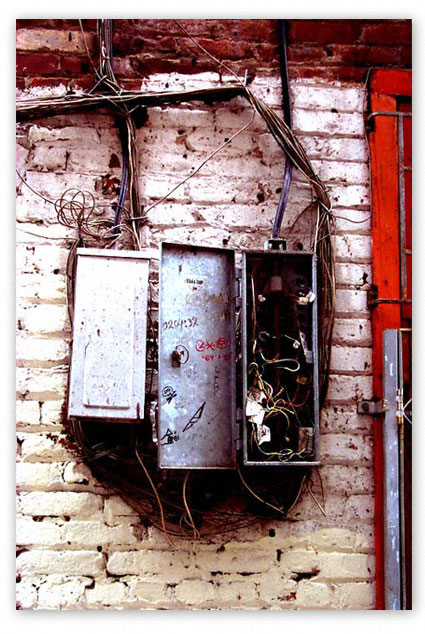
A Chinatown alley, San Francisco.


wired in chinatown

This was my first trip back to San Francisco after leaving Radical. Their office on Berry St. in China Basin had since shut down when I came back in 2001 for the Webby Awards, CBC Radio 3’s first time nominated . I found the irony of this telco box in the high-tech mecca of North America too much to resist. From what I could tell it was still functioning, in spite of (or perhaps because of) a few sketchy looking splices.

Sphere: Related Content

A Stern Warning

August 20, 2005


a stern warning

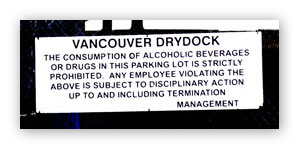
A once proud master of the high seas now sits welded in place, part of a major redevelopment of the old shipyards in North Vancouver. Soon to be surrounded by condos and sparkling retail stores, I’m sure they’ll clean her up before the yuppies move in.

warning

Sphere: Related Content

Hot Day, Minor Thoughts.

August 19, 2005

It’s another hot, 30 degree day in Vancouver, and it reminded me of the early morning heat of South America.

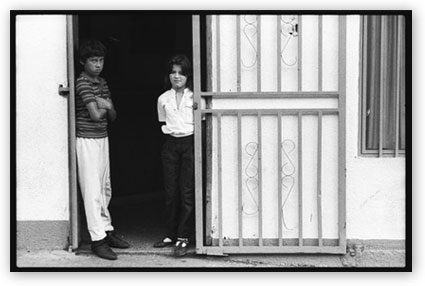
These kids would be in their mid-twenties by now. Taken early one morning, after a late night of Polar beer and loads of food. I stumbled out of my hammock in La Puerta, Venezuela. A lovely town, with warm and wonderful people. I wish I had stayed for weeks instead of two days. It was 1987 and three days earlier I had been on assignment in Yellowknife, North West Territories, so it was a bit surreal


two kids in a doorway in La Puerta

Today’s minor thought about the CBC lock-out.

Those clever CBC folks.

It’s too bad the CMG, the union that represents those locked out employees at CBC, don’t get the web or the Internet. With the lockout at CBC, it would be the perfect opportunity to use the power of the ‘Net.

Lots of their members do - but most of them have found themselves without email, since they’ve relied on their free corporate email accounts. CBC has a very good web interface to their mail system and one of the perks of working there is web mail. Understandably, most treat it like a personal account, so much so that some were surprised when it was shut down. Doh. If the union was thinking, they’d adopt the same naming conventions used by CBC, (firstname_lastname@cbc.ca) and give all their members email accounts with a cmg.ca domain instead of their cbc.ca domain.

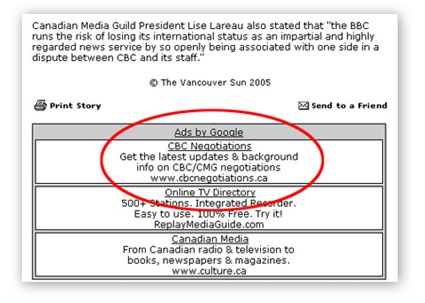
Meanwhile, CBC’s heft in the media world shows up in the most interesting ways. In today’s Vancouver Sun online edition, a long story about the union complaints about BBC material on CBC, and how they’re rallying their union brothers/sisters in the UK to pressure the BBC. Down at the bottom of the page, as part of a Google Ad buy - there’s the link to the CBC corporate pages , giving their side of the story on the labour dispute. Smart. This is the first of these I’ve seen, but I’m sure they are all over, since CBC has tons of ads in the blogosphere. Chalk one up for good use of the ‘Net.


cbc ad

Meanwhile, there is lots of hoopla over locked out CBC staffers taking up the podCast as one way of flexing their might. It sounds grand - all those talented radio folks especially, out there, quite capable of launching their own alternate service on the web. Five days into the lockout, and so far they’ve only been able to come up 7 minutes of material. Ouch. With luck they’ll make me eat my words.

So far most of the locked out member blogs have been about how hard it is to spend 4 hours on picket duty. Tod Maffin has a list of the union members’ blogs on his site.

Oh, and just for the record, the OUIMET blog from Toronto is no relation to me. This is me here.

Oh x 2. The At Large Media newsletter is out today - you can get a copy at www.atlargemedia.com/news.html

Sphere: Related Content

Next Page »