Here’s a video of an afternoon’s sailing time lapsed out to a minute-and-a-half.
It was a lovely afternoon in Howe Sound, with a nice breeze from the Strait of Georgia. Madsu’s under a full main and a 100% jib and moving along nicely.
The camera is a GoPro Hero2 mounted on a Horizon True hydraulic mount. I’ll be experimenting with different camera placement over the summer – this was mounted on the pushpit, a bit to port. The mount is a real delight, and now has its own Pelican case for bringing down to the boat.
In the grand scheme of things, this is hardy an earth shattering issue – it’s just software.
But if you use video editing software as part of your work as I do, it means having to make some decisions about the future investment in this particular software.
I’ve been editing for a long time. I actually remember the first time I cut a piece of audio tape and spliced it back together back at CKDM in Dauphin. It was 1972.
I worked with some of the very first non-linear audio editing software packages – all of them flakey and buggy compared to what we have today. I used pretty much every audio editing tool made until I settled on Pro Tools.
When I started editing video I was interested in desktop PC based solutions rather than the expensive production house alternatives. I started with Premiere on the PC, then switched to Final Cut Pro on the Mac. All that to say that I’m an early adopter and look forward to using the latest, newest tools available to me. And I’m willing to put up with a bit of uncertainty if the benefits outweigh the risks.
I’ve been using Final Cut for 6 or 7 years now. I like it very much. Even my kids, in grades 8 and 11 , prefer to use Final Cut over iMovie for their school projects because sharing data is easier, and Final Cut provides the right kind of control over editing.
Like a lot of people, I have been looking forward to a long overdue update to Final Cut – mostly to improve speed and file management. When Final Cut Pro X was finally unveiled this week, I was excited to discover they’ve made huge leaps in performance and really improved file management.
But I’m mightily disappointed.
Without getting any further into the debate, it simply is taking things in the wrong direction; I can’t use my existing Final Cut projects with it, I can’t easily export audio for post production, and it’s taken too many of the control features out of my hands.
It’s possible that Apple will restore some of the things it has taken out of the software, but for me, this is simply a matter of making a decision based on my business needs.
Like any decision, I try to ‘read the signs’ to see where things are going. All I have to go on is what Apple has done, and what it says it will do, with the software.
The signs aren’t good.
The two main issues for me are collaboration and backward compatibility.
Making it more difficult (or expensive) for me to export audio for post production is a major deal. Because I’m an audio editor as well as a video editor, I always treat and master my audio in another program and then pull it back into Final Cut. With the new version, in order to do that, I’ll need a plug-in that itself costs twice as much as the Final Cut upgrade. It’s more steps, more software, more money, more hassle.
Secondly, there’s the issue of backward compatibility.
This may seem like a small matter, but it’s huge.
Not being able to work with older content means keeping 2 versions of the software on my machine to ensure that I can work on older files down the road if I need to. Eventually that need may disappear, but at least in the immediate future – say 2 or 3 years – it’s critical I am able to work on those old files.
So that means keeping both the old and new versions of Final Cut running. I’m generally trying to reduce the number of types of software I use, not increase it.
Having to maintain and manage 2 versions of the same software just to be able to do my work is annoying. Plus, none of the effects plugins I have bought and used over the years will work with the new version.
If I’m going to have to spend more money just to use the software in the way I want, and I’m going to have to manage 2 versions, then I need to seriously think about switching to something else.
Do I want to do that. No.
Is it a good business decision ? I think so.
Why ?
Here’s the thing – the signs for Final Cut look bad. Sure Apple may make some changes over the next few months, but in the end, they’re taking the software somewhere that doesn’t really fit with my way of working. That’s their business decision, they’ve made it pretty clear. It’s up to me to decide what I want to do about that – not whine about how Apple has let me down (they don’t even know me…)
So what are my options.
I’ve thought about this a lot, and really the only option for me is Avid’s Media Composer.
It’s a professional tool created primarily for professionals. It’s used in broadcast and post-production houses around the world. It isn’t as pretty to look at as Final Cut and it’s more expensive, but it’s rock solid.
What’s more important for me – the signs for the future look good.
Avid knows its market and knows its users. They’re professional editors who use the software every day cutting for news and current affairs show, and editing full length features. They aren’t trying to appeal to a larger video editing market – they’ve concentrated on making a solid tool for industry professionals. And because they also make Pro Tools, the audio editing and mastering software I use, it just makes sense to switch.
And that’s what I’ve done – and am now in the process of learning how to use Media Composer (their help videos are fantastic). We’re lucky here in Vancouver to have a store like Annex Pro – I was able to get set up in just a few hours and using the software the same day.
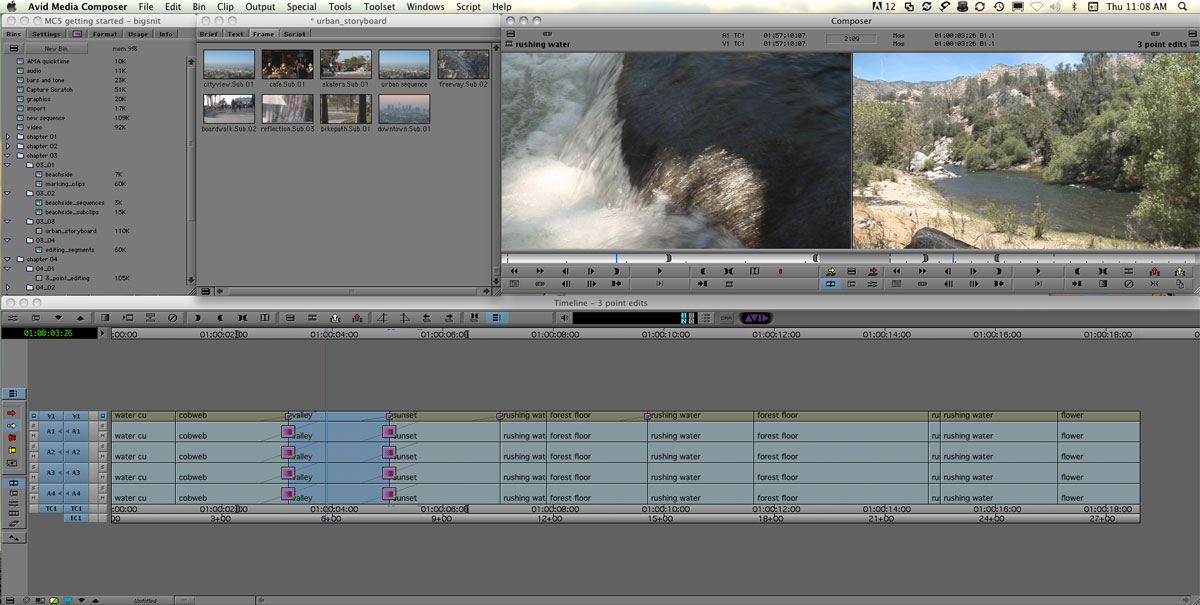
Media Composer on my desktop
Yes, I will still need to keep an old version of Final Cut running in order to work on old projects, but I was going to have to do that anyway.
Yes, I’m having to spend more money, but I was going to have to spend a fair bit just to upgrade Final Cut and then buy yet more plugins to make it do what I need, but never quite getting there.
Most importantly, for my business, I feel confident that 2 or 3 or 5 years from now, Avid will continue to be making the kind of product I need to do my work. I just don’t have the same confidence in the direction Final Cut is going.
There’s a fun multimedia gallery that’s part of the BC Pavilion on the 4th floor of the Vancouver Art Gallery.
I’m working with DigiBC during the games, and many of their members provided the content and technology for the gallery. And friend Sara Bailey, is the curator. Sara worked on some of the earliest CBC Radio 3 designs back in 1999 (prototypes actually) and she and I worked together as consultants for a number of years.
On Wednesday, she offered photographer Kris Krug and I a preview of the gallery (it opened on Friday).
I shot a full ‘tour’ with Sara guiding us through – that will be online in a few days. But I also put together this little piece for Kris.
He and I first met ten years ago when he was publisher of one of Vancouver’s first online magazines and we were just starting to put some definition on what CBC Radio would be.
I’m working with DigiBC on a new project called VXperience, and one of the things we’re doing is spreading the word about British Columbia’s incredible pool of innovators working in a variety of digital sectors.
We’re just starting to gather up some of their stories, but I wanted to get this information out as quickly as possible.
Branko Zurkovic from Upside Wireless emailed to say that IPIPI.com is offering free text messaging to Haiti.
He says the company wanted to do what it could to help out, so their offering their service free – making it possible for friends and relatives to text to either of the networks in Haiti for free.
“We start to accept that ridiculous language in which citizens are referred to by politicians and administrators as clients.
We’re not clients of government.
We own the government, it’s our government.
There isn’t a single thing of government which we don’t own, how could we be clients ?
And we aren’t buying shoes, we’re talking about the rights of citizens within their own society.
We’re not stakeholders, we’re citizens.”
– John Ralston Saul, speaking at the PLAN 20th Anniversary evening at Christ’s Church Cathedral in Vancouver, November 20, 2009.
John Ralston Saul is an award winning novelist and essayist, and one of Canada’s most outspoken champions of freedom of expression.
His most recent book is called The Collapse of Globalism and the Reinvention of the World. It’s just the latest in a series of best selling works that have been translated into 22 languages and sold in over 30 countries. Earlier this year he become the first Canadian to elected president of International PEN, the association of writers devoted to defending freedom of expression.
John is also the patron of PLAN (Planned Lifetime Advocacy Network), and he was the featured guest speaker at PLAN’s recent 20th Anniversary celebration in Vancouver.
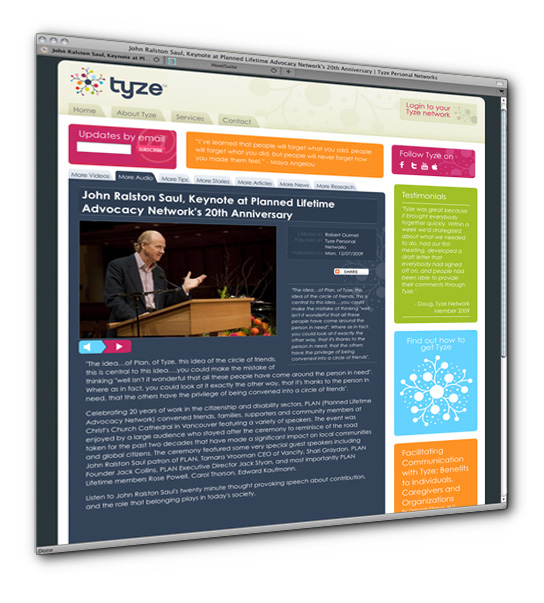
I was asked to record the evening, and you now can hear the John’s keynote on the Tyze.com website, or listen to it here.
I’ve been using Slide Show Pro for a while now. It’s real strength comes when you combine it with Slide Show Pro Director, which is a content management system. I use it on the main page of this blog, but also for client sites where I need a rotating banner that’s going to get changed often. Adding new images to the slide show is simply a matter of uploading them to the CMS, and nothing needs to be changed on the website itself.
First story. It’s only surprising it’s taken this long for someone to turn up evidence that big tobacco knew ages ago that cigs are bad for you…
Imperial Tobacco Canada destroyed up to 60 early studies that linked cigarettes to addiction and carcinogens, according to a review published Wednesday in the online Canadian Medical Association Journal. (full story here)
Perhaps not surprisingly, Imperial Tobacco makes no mention of this on their web site, but proudly proclaims this:
We’re an international tobacco company focused on creating value for our shareholders.
Imperial Tobacco products are available in over 160 countries worldwide. Our geographic diversity and versatile multi-product portfolio provides business resilience and a strong platform for future growth.
Future growth ! Shareholder value !
Well guess what ? All the future growth and shareholder value is based on a product that will kill you.
My sister, a 2 pack a day smoker, died of lung cancer in her early 40’s. I was with her when she died.
Not a lot of future growth there, fellas.
Second story.
It’s surprising someone gave university researchers a $150,000 car to do this study, proving that fast cars and testosterone are linked.
Well, duh.
Researchers at Concordia University’s John Molson School of Business in Montreal took 39 willing young men and let them take a cruise in a $150,000 Porsche 911 Carrera Cabriolet.
The men were then asked to drive a 16-year-old Toyota Camry. (full story here)
According to the lead researcher, “just put a guy in a Porsche, and his testosterone levels shoot up”.
Well, duh again.
But hang on here.
Every time I get in our Toyota Yaris, I most definitely have a little testosterone thing going on. Fully loaded, the Yaris clocks in at under 20-grand and even used to get a gas-miser rebate from the feds.
Maybe the John Molson School of Business should come out here and do a little study on us West Coast Men.
It’s been great working with the gang at biovia this spring.
Today we launched their new website…
biovia is a Vancouver-based wholesale distributor specializing in local + organic produce including fruit, vegetables, herbs, micro and leafy field greens and eggs. We deliver to the foodservice industry throughout the Vancouver, sea to sky corridor and Whistler regions. We place the highest priority on purchasing locally.
The idea is for the biovia team to manage the site themselves, so the site is built using WordPress as the CMS, with Slide Show Pro handling the flash banners on the home page.
This is the first phase of an on-going online project with biovia and I’m looking forward to seeing how things unfold. They’re the nicest people.
I’ve just finished some video work for BasicGov, a really interesting Vancouver based company that’s addressing the needs of small and medium sized local government all over North America.
These folks are clever.
Using an SaaS (Software as a Service) model, they’re providing a package of admin and organizational tools to local governments.
Typically, these tools are only available through expensive enterprise software – and the little guys find themselves making do with patched together solutions for tracking things like building permits , code enforcement, or planning. BasicGov’s approach seems even more relevant given the current economy.
What these guys have done is distill the key services required and created a web-based solution. Their clients have no technology overhead to deal with, they pay on monthly subscription basis, so they can start without spending heaps of cash, and all they need in place is an internet connection and a browser.
The goal of this project was to provide a high-level overview of the suite of products – essentially an introduction to the concept of SaaS without ever using the acronym, and how these products help solve specific challenges faced by small governments.
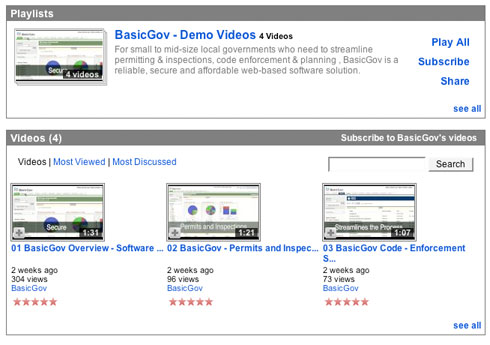
BasicGov, wisely, is using YouTube as a key platform to distribute these videos.
It’s fitting, considering their own model.
Just like their own service, using YouTube allows them to get all the benefits of a large scale distribution platform, with zero overhead. The idea is to use the videos as an introduction to the services, not as a ‘how to’ per se – though we may do some of those later.
Creating the videos gave me an interesting insight into their product as well. The team sat down with me and walked though each of the 3 key modules. I took notes, but mostly I was just trying to get oriented. I’ve never worked in local government, so a lot of the details were new to me.
Often with this type of software, a casual observer (me) will find it difficult to retrace their way through the various functions. I was surprised when I logged on back at my office, and discovered I was able to work my way through all the pieces with ease. Which of course was one of the goals BasicGov laid out when they started.
PRODUCTION
We worked through an iterative process, using storyboards to identify key screens and copy.
I often use Final Draft A/V for this kind of thing, but in this case, I opted for Story Board Quick. I like being able to generate HTML and FLASH versions of the boards – I work virtually most of the time and it makes sharing the info with the client quick. I also strip out the copy and provide the client with a clean copy deck – often this is the easiest place for them to identify changes.
For screen capture, I knew I wanted something other than Camtasia. It’s not really a Mac or PC thing, I work with both (I do all my audio on PC). Given that I planned on editing on Final Cut at high resolution, I wanted something clean and lean that made it easy for me to get the screens I wanted, with the zoom factor I wanted, etc.
I opted for I Show U HD. It plays nice with Mac and was rock solid. It was a real bonus being able to select from a variety of resolutions and frame rates – I imported all my clips directly to FCP.
Through the process I created rough cuts for the client to review. These I provided to them in Flash Video – using Adobe’s CS4 media encoder. I was then able to load them up on a server for them to grab and review at their convenience. What this meant was that we were able to move through more iterations faster than would have been the case with ‘in person’ reviews.
Once we finalized the copy of flow, I created a ‘finished’ voice track to replace my working tracks. I record all my audio on a Sound Devices 702T through a 422 field mixer. Then I haul the audio into Adobe Audition for editing, and master with T-Racks 24, then haul the mastered files back into Final Cut.
Because BasicGov wanted to take advantage of YouTube’s HD options, everything was captured at 1280 x 720, and the YouTube versions, both regular and HD, looks great. You can see them here:
This is specific to American Express, but I’m sure it’s an issue with other credit cards as well.
I’ve always believed that if there was a charge on my card that I didn’t agree with, all I had to do was call the credit card company to get it removed.
In the past, when it’s come up, that’s exactly what I’ve done, and there’s never been any hesitation on the part of the card company.
Apparently I was wrong.
Today I hit an interesting issue, and I’m both surprised and disappointed in American Express’s policy regarding recurring or negative option billing.
In December of 2006 I purchased a 2 year membership to Classmates.com. This was before Facebook pretty much destroyed their business model.
I received an invoice from them at the time which states the 59.00 USD fee was for a 2 year period.
Nowhere on the receipt does it indicate that I’ve agreed to any kind of automatic renewal or recurring billing, but it does indicate a ‘renewal date’ of December 2008.
When I received my Amex bill in the mail today, there was a 59.00 USD charge from Classmates.com. I called Amex to ask them to remove the charge.
Not so easy.
According to Amex, because the merchant (i.e. Classmates) has indicated it is a recurring charge, Amex will not reverse the payment without proof that I’ve canceled my membership.
Ok. So, with the Amex agent on the line, I pull up my receipt and send it to her:
The agent then tells me that nowhere on the receipt does it indicated that I’ve NOT agreed to renewal.
Huh ?
She then looks online and says that the Classmates site indicates that memberships are automatically renewed. Maybe today it does, but that doesn’t mean that it did in 2006 when I did the original transaction, and beside, the receipt doesn’t indicate that.
Not good enough says American Express. I need to prove that I haven’t renewed, some VALID indication that I DIDN’T agree to autorenew.
Hmmm. Me on the phone saying I didn’t ? Not good enough.
Of course it’s impossible to call the vendor (American Express even tried with me on the phone) and an email to them results in an auto reply. Interesting, the reply explains how to turn off auto renew (even though I never turned it on).
The problem is that only stops it for the next renewal, scheduled for December 2010, and doesn’t help me with my current billing problem.
Surprisingly, neither will American Express help me.
The Government of Ontario even has an advisory on their web site about it. They’ve even passed laws to try to stop it. Did I mention that it’s a terrible business practice – desperation really. I’m surprised that American Express is so supportive of merchants doing business this way – to the point of siding with them over their card holders.
According to the agent, if the vendor claims the charge is recurring, then American Express takes the side of the merchant, until the customer can PROVE they didn’t agree to a recurring charge. And from my example, supplying a copy of the receipt that clearly indicates a 2 year term and DOESN’T indicate an autorenewal just isn’t good enough.
Based on this position, any merchant you’ve ever conducted an online transaction with, who claims to have a recurring billing arrangement with you, CAN put through a charge. And your credit card (or at least American Express) will not reverse if if you call them to tell them you never agreed to such a thing.
Ironically, our credit card companies have for years been trying to reassure us that online purchasing can be safe. Here’s a straight forward example where the immediate response from the card company should be simple:
Remove the charge. The client says they didn’t authorize it. Simple.
Instead. American Express sides with the vendor, leaving the customer hanging in the cold. The problem with this of course is that any merchant I’ve done business with in the past could easily put through a transaction for any amount claiming it was a ‘renewal’. As I said at the top, I’ve always believed that solving any such problem was as simple as a phone call to the credit card company, Apparently not so, as long as the vendor claims it’s a recurring charge.
What’s irritating is that the agent at American Express kept saying that I “must have agreed to recurring billing” when I did the original transaction. I explained over and over that I did not, regardless of what Classmates.com claimss. There’s any number of changes they could have made to their policies in the 2 years since my original purchase, and even sending a copy of the receipt to Amex didn’t change their position one bit. I really annoys me that they can be so dismissive of a customer, while that customer is on the phone with them.
Perhaps Amex should be advertising with the words of the agent who was on the phone with me: “If you’re going to buy on the internet, it’s buyer beware”
I’m sure I’ll eventually get hold of someone at Classmates.com and will get the charges removed, but if you can’t reach the merchant, good luck convincing your credit card company that you never agreed to be billed on a recurring basis.
Sorry for anyone who was getting “page not found” returns on some of the items on the front page of the blog. I’d installed a new plug-in that was a bigtover-earnest in rewriting URLs.
One of the great things about WordPress is the sheer volume of plug-ins created to provide all sorts of functionality and features. Sometimes they choke, and my fault for not re-checking what was happening after I installed this one.
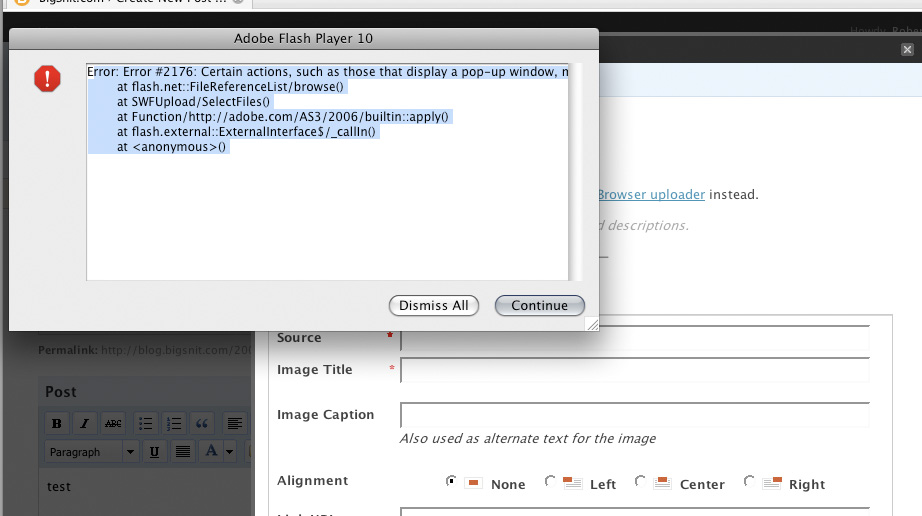
I’m not sure how I missed it, but if you’re a WordPress user and you love the image upload function, stay away from Flash 10. It borks the uploader – and you’ll need to revert to Flash 9 or use the browser upload instead.
The WP forum ‘closed’ topic on image upload problems does mention this, but I hadn’t gone back to that doc since reading it the first time (trying to solve other image upload problems).
The WP forum seems to indicate its an issue especially for Linux, but the WP Image uploader for definitely doesn’t work with WP on my Intel Mac when running Flash 10.
Fortunately I was able to find my old Flash V9 player and reinstalled it.
Error #2176: Certain actions, such as those that display a pop-up window, may only be invoked upon user interaction, for example by a mouse click or button press.
at flash.net::FileReferenceList/browse()
at SWFUpload/SelectFiles()
at Function/http://adobe.com/AS3/2006/builtin::apply()
at flash.external::ExternalInterface$/_callIn()
at <anonymous>()
Its not too often, in fact it’s never happened to me before, that you get offered a free book while waiting in line to see a stage play.
The man with the bag of books is director Brian Anderson who’s done an amazing job with Gutenberg! the Musical!
The free paperback is just the first of many treats in store as characters Bud and Doug take us on a ‘reading of the musical’ they’ve written about the man who invented the printing press. Defeated by Google in their attempt at researching Johann Gutenberg, Bud and Doug opt instead for an ‘historical fiction’ version – as they say “It’s fiction – but its true”.
The two actors, like director Anderson, are both Theatre Sports vets – Nathan Clark plays Doug, and Ken Lawson plays Bud. The two play over 20 characters, including a complete Broadway chorus line and a bevy of singing mice rats.
They sing, they dance, they cry; more importantly, they pull it off. Under the deft and thoughtful direction of Anderson, what could easily turn into a big broad mess wins us over within the first few minutes, and holds right until the end.
In this show timing is everything, and Clark and Lawson never miss a beat – or rather – know when to take a beat, and let the comedy work. A good Fringe show pulls you into its big warm bosum and smothers you with heart – these guys, along with pianist Matt Grinke (who’s awesome), ace it.
– – – – –
There are only 3 shows left – Sept 10th at 9:15, Sept 13th at 3:15, and Sept 14th at 7:15. Advance tickets at the Festival Box office or at the venue (the Arts Club mainstage on Granville Island) 50 minutes before the show.
It’s been five years since I worked at CBC – but this week I’ve been pummeled with questions about CBC Radio Two.
Oops. Sorry.
Radio 2.
Once known as CBC Stereo, and beloved as “Classics and Beyond”, the CBC’s other radio network has become The New 2.
The New 2 is sporting a funky URL (thenew2.ca) that takes you to the same old URL (cbc.ca), and more fonts than you can shake a stick at…
Oh. And there are on-air changes as well.
Those changes have sparked yet another online protest by Friends of Canadian Broadcasting, who seem to have missed the importance of the number 2, and have focused instead on the actual content of the network, with their WHO? campaign.
I’ve received two (2) emails from Ian Morrison of Friends of Canadian Broadcasting who wants to enlist help in fighting the changes to Radio 2 (two).
We believe the Radio Two changes are consistent with the misguided approach of CBC’s current management group to “dumb down” CBC’s programs in search for a new and broader audience without regard for the damage this will do to its current loyal listeners.
We also believe that these changes signal CBC’s intention to ask the CRTC for permission to advertise on CBC Radio.
So, what’s all the fuss about ? And why are all my friends and neighbours assaulting me with questions about The New 2 ?
A few were thinking this was some sort of long-weekend-hang-over-programming-error. You know, with the B team working the holiday weekend, someone loaded the wrong tapes in master control.
One called this afternoon asking if CBC was ‘trying something out’ since it was Wednesday and the kids are back in school.
Another (who knows a little of my history at CBC and the long fights we had convincing the the corp to let us call our online network Radio 3 instead of Radio Three) just emailed the classic text shorthand: WTF ?
The thing about it is this – it’s not that important.
They’ve made some programming changes.
Some of the new shows will be good and some won’t.
If they leave them on the air long enough people will get used to them, or they’ll find their niche audience, or they’ll just be mediocre and have small audiences.
Just like the old Radio Two.
See, it’s really hard to create any kind of broad or mass audience with ‘appointment’ radio programming.
The New 2 will have the same kind of small dedicated audience that the Old Two had.
It’ll just be a somewhat different audience, an audience that likes an off-centre, not ready for prime-time program. Just like the old Radio Two audience.
All the new hosts have that raised-on-DNTO sound. Just like all the old hosts had that Wanna-BBC sound.
The important thing to keep in mind is: it’s just a radio channel. There are others.
I know with the long weekend ahead, you’ve been wondering about the state of media in Canada – now you can rest easy and enjoy that extra day off.
Big Media in Canada is doing just fine.
Again.
Still.
The CRTC today released its Communications Monitoring Report. In the past the Commission published one report on the state of broadcasting, and one on the telecommunications industry, and this is the first of their ‘converged’ reports – presumably to reflect the state of the industry.
The report makes it clear that the Canadian broadcast sector is doing just fine, despite dire warnings of its impending demise thanks to the internet. The report also shows just how big a role the internet plays in our every day lives and consumption of entertainment.
Here are some facts pulled from the CRTC report.
Money…
Revenues for private commercial radio stations increased by 6.2%, from $1.4 billion in 2006 to $1.5 billion in 2007.
Commercial television revenues increased 4.3%, or $218 million, from $5 billion in 2006 to $5.3 billion in 2007. This was largely due to increased subscriber revenues of $152 million.
Revenues for specialty, pay and pay-per-view television and video-on-demand services increased by 9%, rising from $2.5 billion in 2006 to $2.7 billion in 2007.
Revenues for private conventional television broadcasters went from $2.1 billion in 2006 to $2.2 billion in 2007, an increase of 1.3%. During this period, revenues for English-language stations grew by 2% to $1.8 billion, while those for French-language stations fell by 2% to $381 million
Online advertising continued to experience growth, with spending rising from $900 million in 2006 to $1.2 billion in 2007.
English Canadian use of…
RADIO: 18.3 hours of per week
TV: 26.8 hours of per week
INTERNET: 13.4 hours per wee
Habits…
The number of Canadians who have watched a video online has more than doubled over the past three years, with user-generated content being more popular than professionally produced programs.
Among the more popular online activities in 2007, 36% of Canadians watched a video, 16% listened to a streaming radio station and 17% downloaded music.
11% of Canadians reported downloading and listening to a podcast on either their computer or an MP3 player, an activity that is seen as a complement to conventional broadcasting.
Today’s CRTC report shows that we are in fact using the internet for entertainment. One of the most popular online activites happens to be…watching videos. At the end of the day, regardless of the facts, the CBC’s argument in it’s submission seems to be that since it hasn’t figured out how to make money online, online shouldn’t be considered a business opportunity for Canadian broadcasters.
Given that traditional broadcast is still showing yearly increases in revenue, I’m not sure they’re in any hurry to try figure out how to make money online, despite the fact that Canadians are consuming a huge amount of content online. To my mind, that bodes well for smart nimble companies that can jump into this obviously ripe market while the ‘big boys’ sit back and wait for it to be a more predictable business opportunity.
I’ve just posted some notes on a project I really enjoyed working on for Dr. Tony Bates, a former professor at UBC. It was an interesting challenge organizing his huge library of content – great guy to work with.
I’m now heading into week 3 of trying to get my MacBook Pro airport fixed. I’ve been to the Apple Genius bar 3 times, they’ve worked on my machine twice, and after picking it up today it worked for about 2 hours then stopped.
The first time I brought it in, 2 weeks ago, they spent about half an hour at the ‘bar’ trying to figure out if it was a software or hardware issue. After decided it was hardware, they checked and by some miracle had a replacement airport in stock. I have Apple Care Pro so I left the machine with the promise of getting it back the next day.
Apple called the next day to say that they now thought it was the antennae, not the airport itself. One problem. That’s another part, and this they didn’t have in stock.
So I drove back downtown to pick up the machine since they expected it would be 10 days to get a part from California (huh ? Does Jobs drive them up here himself, on a bike? )
On Thursday (11 days later, but who’s counting) they called to say the antennae had indeed arrived. I dropped the machine off on Friday afternoon and Saturday morning (today) they called to say it was done.
Nice. Well, for 100 bucks a year you get 24 hour turn around on repairs, so they were just doing what they promised, but still, nice.
But Wait.
All excitement should be put on hold.
The wifi worked while I got mail and sent some photos up to the web site. When I came back to the machine 2 hours later, back to the flakey on/off airport reception, which is mostly off. It looks like maybe a physical connection problem – one second it’s showing 4 bars the next none.
So I’m tethered again (lan cable).
A call to the Apple Store netted a ‘…um, I’ll have a manager call you back’. Dude, I’m still waiting…
Can someone tell me, is this a normal experience at the Apple Genius Bar,
OR
is Vancouver particularly genius challenged ?
UPDATE:
No-one ever did call me back from the Apple Store. So I called at noon today, and just got off the phone after speaking with 3 people there.
What a nightmare.
Apparently if the Apple Genius decides a machine is working, then it doesn’t really matter what you the customer thinks since ‘we’ve run our diagnostics and it was fine’.
The upshot is that I will now be heading to the Apple store for the 4th time to see if they can actually fix my airport.
Here’s the thing – if I had a PC I’d just plug in an external wireless receiver but I can’t on the Mac, so I’m really hooped.
Maybe the Apple Genius will replace parts one at a time until they get it right ?
I’ll keep you posted.
UPDATE UPDATE (july 21):
Woaw. Night and Day. I got a call this morning from one of the first people I talked to at th Apple Store, who obviously IS a genius. It was like night and day – super helpful in trying to figure out what might be going on with my machine and wanting to solve the problem. A big thumbs up to Adam at the Apple Store in Vancouver ! Still have to resolve the issue, but at least now there’s someone there willing to order parts BEFORE having me come in.
 Here’s a video of an afternoon’s sailing time lapsed out to a minute-and-a-half.