
Finding some beauty in the rain today.
Just had to step out my front door and see things with a slightly different lens.
Even on a drag grey day, the colours are there, you just have to find them.
Finding some beauty in the rain today.
Just had to step out my front door and see things with a slightly different lens.
Even on a drag grey day, the colours are there, you just have to find them.
super sabrina to the rescue. not too many dentists around that you can call friday and get to see sat morning. tooth feeling much better tnx
The latest radio ratings came out this week, and CBC Radio One is congratulating itself for one of its best ratings periods ever.
On closer look though, it seems that, like every other radio station in the world, there’s a fair bit of selective fun with numbers going on.
Here’s the headline from CBC’s official blog:
CBC Radio cleaned up in the latest audience measurement report released by BBM.
In radio they call it the book, and it was an outstanding showing
(You can get also get an overview of the ratings, nation wide, at Broadcaster magazine.)
In Toronto, CBC is high-fiving for becoming “number one” for the first time ever.
CBLAFM are the call letters of Toronto’s CBC flagship – and it scored a 9.4 share in this round or ratings.
BBM defines share as “total hours tuned to that station expressed as a percentage of total hours tuned to all radio” in the market.
That’s great of course, but there are some in the broadcast industry who think very little of share. Mostly because if your listeners keep their radio tuned for long period of times, your share will be higher, even though a competitor may have more listeners.
Most commercial stations look at reach – defined by BBM as “estimated number of different people, within…the market area, who tuned to that station for at least a quarter hour during the week”
In other words, how many people are actually listening.
Within CBC, making Toronto local radio a winner is a huge deal – and for any of my former colleagues who are celebrating this weekend, good on you.
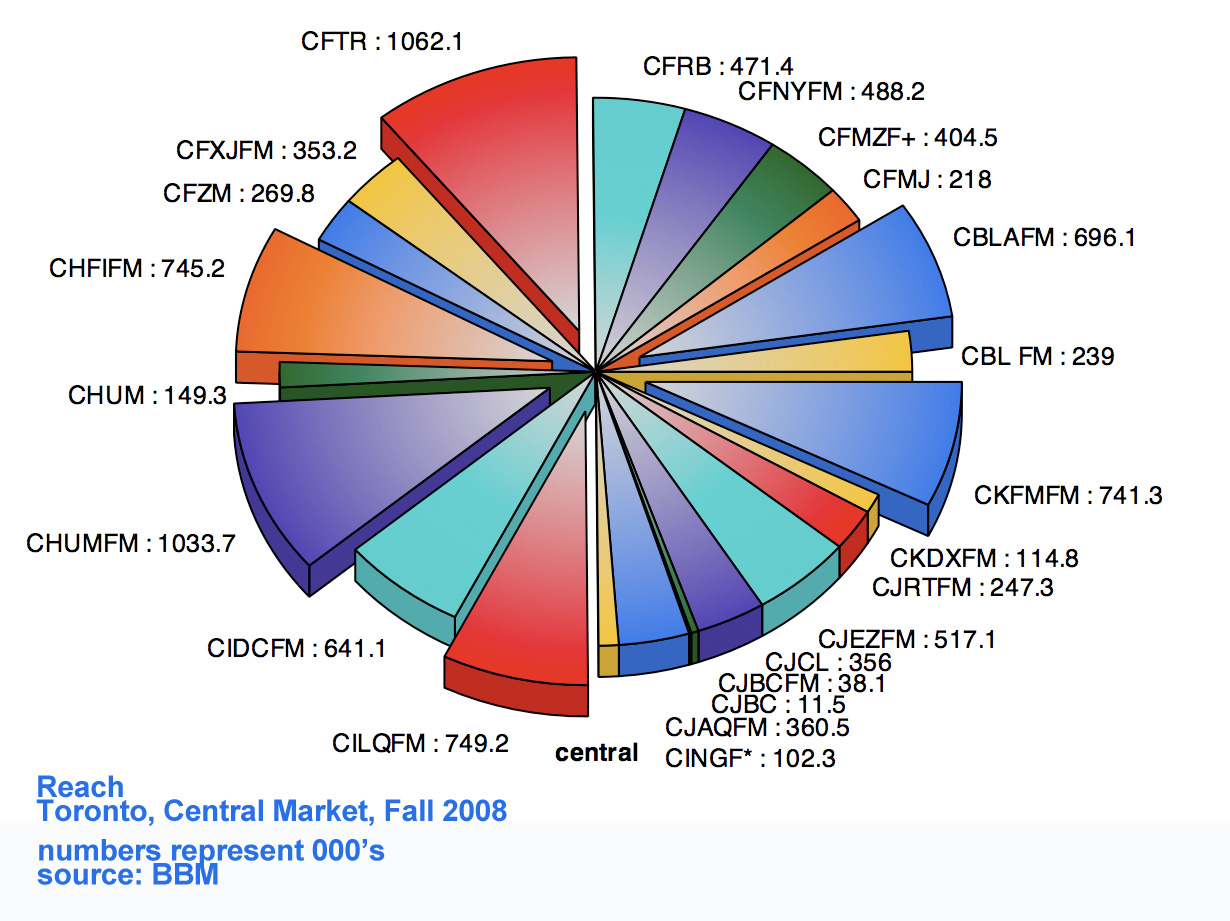
But when you look at CBL’s reach, whether in the central market (i.e. the city) or full coverage (the entire broadcast range), it’s far from number one.
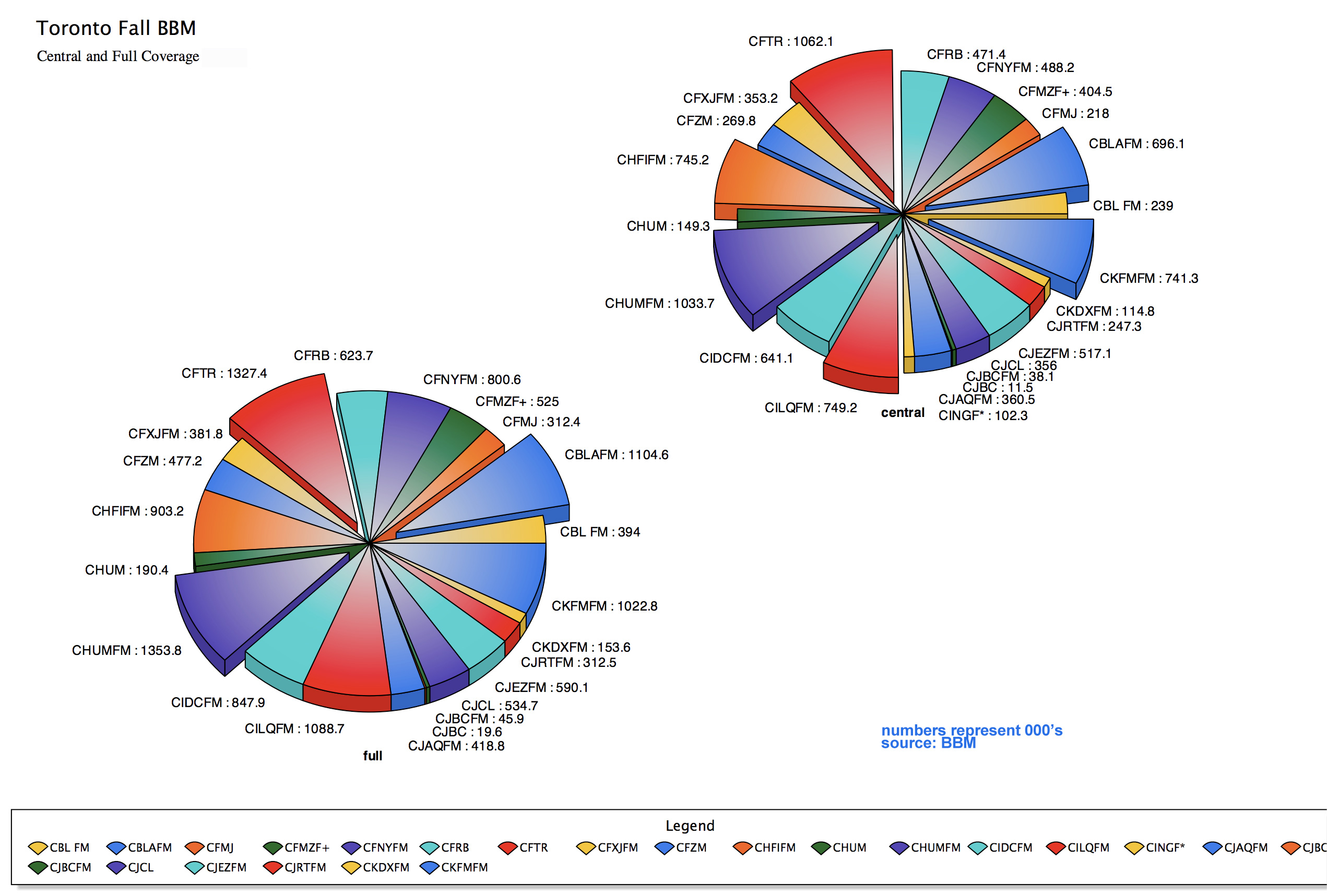
In full coverage reach, CBL comes in 3rd in the 17 stations identify by BBM
And in the central area of Toronto, CBL does less well. With 696,100 listeners, they’re in 5th place.
In Vancouver, it’s a slightly different story, and very different numbers.
Unlike Toronto, CBC Vancouver won’t be using share to claim number one spot – that’s because in share they’re second, well behind CKNW.
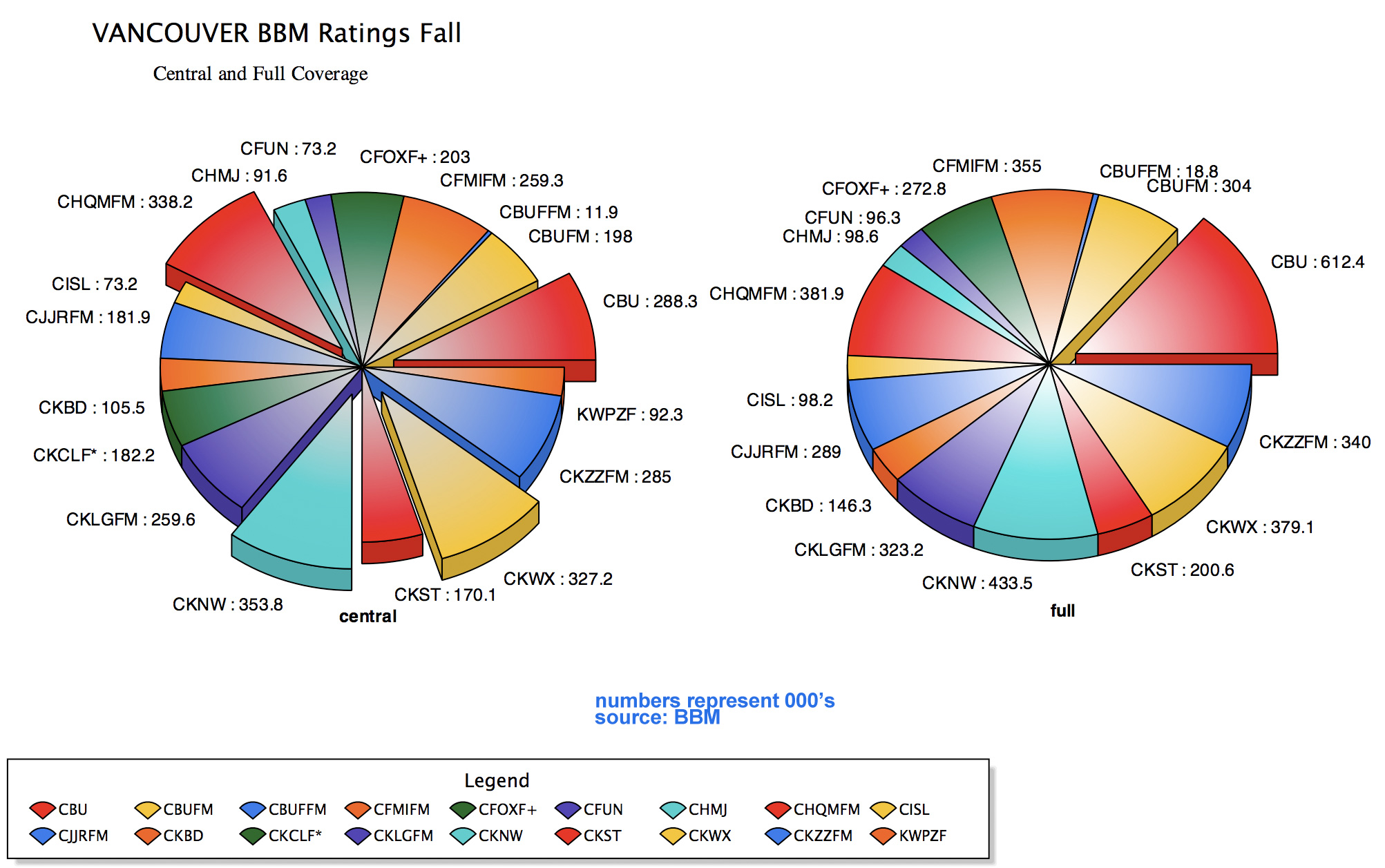
What does make Vancouver CBC number one is a great technical infrastructure. Their full coverage reach is an awesome 612,400 listeners, thanks to excellent transmitter coverage across the lower mainland. This is miles ahead of their closest competitor – and their closest full coverage reach competitor isn’t news/talk station CKNW, but CFBTFM – better known to you as The Beat.
When it comes to the Vancouver central area however, the numbers go quite differently, with CBC well behind CKNW, CFBTFM, CHQM and are on par with CKZZ.
In Vancouver central, CBC Radio One is actually 4th.

What does it all mean ?
Externally, nothing really.
CBC Radio doesn’t currently sell advertising so they can claim #1 all they want, but when the radio sales teams from private stations hit the street to sell, CBC isn’t even on their chart.
Internally – it means everything, particularly as CBC eyes the current government cuts with apprehension.
You just had to listen to Heritage Minister James Moore interviewed on CBC Vancouver this week to hear how big a concern it is for CBC. Speaking to him about the government’s financial plan, on no other question did they push him for an answer except for one – will CBC be getting cut. When minister Moore didn’t answer the question directly, they went on to ask it 2 more times.
The other issue for CBC surrounds CBC Radio Two. With massive changes to the schedule last fall, the ratings are not looking good. So having a great story to tell about CBC Radio One will go a long way to deflecting the heat on Radio Two’s poor performance.
—-
The full BBM highlights are online and summary level information is a free PDF dowload, so have a look and make your own charts and graphs to show how your station in #1, in something.
I’ve got a couple of other charts you can take a look at. Like those above, click for a larger version.

One thing about tough economic times, you’ve really got to open your mind to new and different opportunities.
Fortunately, tough economic times tend to surface loads of off-the-beaten-track jobs, just there for the taking. What ever would we do without the internet…
When Times Get Tough, The Rich Call the Butler
Forget about trying to become a millionaire – learn how to serve one.
If you’re Canadian, apparently your butlering skills are highly in demand with the world’s rich and elite.
The web site is a bit short on detail and long on hyperbole, but a career as a butler, serving the rich and famous, might be just for you.
Makes deciding on what to wear in the morning a piece of cake.
When Times Get Tough, More People are Walking
And those people need shoes.
Shoe Warehouse heads its Craigslist ad with “Looming Recession Got You Thinking?”.
Your answer might be “Sure, but not about shoes”.
But remember – tough times means opening yourself up to new opportunities. But be warned, one of the main job requirements is “MUST be able to take direction and complete tasks within a specified time frame”.
Hmmm. I always thought that’s what JOB meant ?
When Times Get Tough, Head to the Bar
If I had known I could buy a pub for less than the price of a house in Vancouver, I’d have so been there.
Who knew ? I think I’d be great behind one of those long hardwood bars, drawing a nice dark ale for the locals and maybe leading in a few great Canadian drinking songs.
Those of you who know me, know how right this would be.
When Times Get Tough, Aim for a Unique Job
Baby Associate, Diener, or any one of these 37 occupations.
When Times Get Tough, You Can Always Count on Bad News
CTV just laid off over a hundred people, but CBC’s hiring.
Not only that, they’re looking to fill a fresh new vacancy. After just over a year in the job, John Cruikshank is leaving as head of news. He’s been appointed publisher of the Toronto Star starting Jan 1.
If managing a bunch of hard-core journalists and bossing Peter Mansbridge around doesn’t do it for you, there are 42 other jobs open at CBC as of today, so take your pick.
Twitter has run up against the great Canadian mobile phone reality. Even something as simple as text messaging is messed up here.
GigaOm has the skinny – basically Twitter can’t afford the Canadian carriers’ text costs – so while you’ll still be able to send your messages to Twitter – no more outbound from Twitter to Canadian mobile device…
Unexpected changes in our billing have forced us into a difficult situation with our Canadian SMS service. We can’t afford to support this service given our current arrangement with our providers (where costs have been doubling for the past several months.) As a result, effective today we are no longer delivering outbound SMS over our Canadian shortcode (21212). The ability to update Twitter over SMS will still be supported over 21212. But we know that this is only part of the experience and we want to make Twitter work in the way folks want … regardless of where they live. There is a realistic, scalable SMS solution for Canada (and the rest of the world.) We’re working on that and will post more details on the Twitter blog as we make progress
more at GigaOm
For us Canadians, this takes away one of Twitter’s most powerful aspects – live-in-situ updates – whether that’s at a party, conference or just a sunny day at the beach. We’ll still be able to Twitter about it with our phone, but the only ones who’ll receive them will have to be on a browser.
Which begs the question.
If a Tweet falls in the Canadian Forest – does anybody hear ?
sniffles and sore throat are back. annoying. time for some apple cider vinegar and lemon and maybe some nice dark jamaican rum for a chaser
like these cool nights for that quick dash from the back door to the hut tub
tweetarts! http://www.vangogreen.com finally tweets too
i washed my hair. now I’m eating chips. the ultimate blog post.
here comes the rain – hopefully this means snow up top – we wuz boarding on cypress at this time 2 years ago…

How energy efficient is your game console ? Not very.
The short story is this.
If you’ve got a video game console in your house, and you leave it on, you’re wasting energy.
The exception – the Nintendo Wii.
A new report by the National Resources Defense Council surfaces some pretty interesting data – and a clear message (note that figures are for US only):
Through the incorporation of more user-friendly power management features, we could save approximately 11 billion kWh of electricity per year, cut our nation’s electricity bill by more than $1 billion per year, and avoid emissions of more than 7 million tons of CO2 each year. In this November 2008 issue paper, NRDC provides recommendations for users, video game console manufacturers, component suppliers and the software companies that design games for improving the efficiency of video game consoles already in homes as well as future generations of machines yet to hit the shelves.
The full report is available as a PDF from the NRDC web site.
Here’s an example of some of the data they present, and there’s one thing very clear from this chart. You can do something right now, without having to wait for anyone – just turn the darned thing off.

(originally posted to VanGoGreen)

The email in-box is a great guide to the state of the world.
A quick glance through the subject lines of the morning mail is proving to be an accurate gauge to the psyche of the nation, or at least accurate enough to rival the augurs of the ancient Romans.
 On one hand, the Christmas gift idea flood has begun, with new ideas on how to spend money arriving almost hourly.
These cheery greetings come from companies I’ve bought from in the past, and dozens I haven’t.
They’re seductive and appealing, providing countless reasons to buy buy buy, and spend spend spend; all on things I don’t really need.
Isn’t it great ?
It’s like an in-box on Alprazolam.

But along with those cheery missives come the not so cheery missiles.
Stark reality.
Barging its way into my plastic subsidized world
From one of my local news stations:
CKNW Breaking News…
Another dark day on the markets; TSX down 766 points, Dow Jones down 445.
Sent 1:32pm
And from Canaccord Capital, a reminder that:
It seems there are lots of stores that are closing due to the “recession” and the fact that people are not shopping. If you have any “gift cards” from these stores, make sure you use them, or you will lose them
The above, followed by a depressing list of major retailers going broke or closing outlets.
Of course, there’s more trouble for big media, now admitting, finally, tough times ahead…
CTV Inc. will lay off some employees, freeze hiring and cut spending to cope with “sharp decreases” in advertising as the television industry braces for a deep slump.
And this from Ipsos (the polling folks)
Year Over Year Online Spending Drops 13% in Q3 2008
Past Three Months Spending Also Down 15%
 Dudes, don’t you realize all this reality is bumming us out ?
I mean, I can only take so much reality – what about you ?
In the word’s of Detective John Kimble in Kindergarden Cop: SCHTOP IT!
Thankfully, at least in my in-box, reality is losing out to Happy Thoughts.
Things like: free shipping, 0% down, and gift cards (while they last) from friendly retailers (while they last).
To which I say: “Keep ’em coming boys, and hey mailbox – pass the bottle would ya?”
The answer is simple.
Cruising with Madsu on a typical BC summer day.
It’s possible it gets better than this, but I doubt it
A little reminder of what to expect (again) in just a few months. And really just an excuse for me to futz with Final Cut Studio 2 which arrived this week.
28 dvd’s later, archive is done –
off the other side of the desk, writing DVD 4of28 as I archive a client project – 😉 to have Toast’s disc span function and a Sharpie handy
Working Excel sheets with Aretha and the Right Reverend Ray on the Tanoys makes it almost enjoyable
Hard times are hitting the media – sort of.
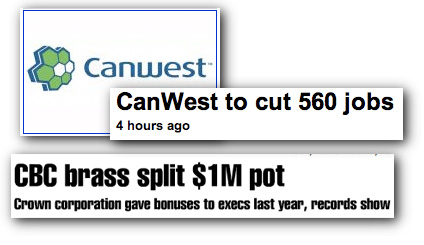
Canwest is laying off 560 employees across Canada – five percent of its staff.
Instead of pink slips, CBC’s giving out performance bonuses to execs.
The optics: bad. The timing: execrable.

South of the border, they’re moaning about layoffs in the publishing sector, including Al Gore’s Current TV.
Meanwhile, North of the border, Al Gore’s Current TV is expanding.
Imagine:
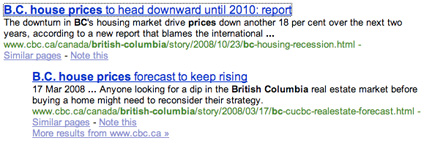
Just like us bloggers, mainstream media seems happy to publish whatever crosses their desk, no questions asked.
How else do you explain a March 2008 prediction of little change to BC’s hot housing market over the next 2 years, and the October 2008 story predicting a drop in house prices of 18 percent over the next two years.
BTW: I have a bridge on offer if you’re interested.
green and clean. mostly. my laundry room’s footprint is improving already http://tinyurl.com/6s49oc
I’ve just posted a podcast with Munu Hicken-Gaberria on VanGoGreen.
Munu’s the guy behind a line of eco-friendly laundry products. Not only are they eco-friendly, but they’re sold in glass jars that are re-usable.
A successful businessman from the UK who fell in love with BC’s natural beauty, he’s doing his bit to try to help the environment. I think you’ll find him interesting and inspiring. He’s based in Port Moody.
According to a CBC story, a candidate in the municipal election in Victoria is complaining there are too many people running for office.
A Victoria mayoral candidate says the large number of candidates running for council is turning the race into an unmanageable circus.
As if to underscore the point, one candidate turned up at a recent all-candidates meeting wearing a clown’s nose and hollering at voters.
Dean Fortin says with 35 people vying for eight seats on council, and eight candidates for mayor, all-candidates meetings have become difficult.
Dude.
It’s called democracy.
And given the track record of ‘legit’ candidates, I’d be careful about pointing fingers.
Sheesh

I’ve been pretty smug about my low carbon recreational footprint. My little sailboat Madsu does have an auxiliary outboard motor, but it’s only on for a short period of time while I motor in and out of the docks at Horseshoe Bay.
The rest of the time, Madsu is under sail.
I do have the need for electricity aboard – power for my running lights, GPS, cabin lights, marine radio and of course my stereo. For that I have small solar charger that keeps my two 12 volt batteries perfectly topped up – in the last 2 years I’ve not once had to plug in to the grid to recharge.
So, when I saw a story in Treehugger about a BC community using sailboats to lower their food carbon footprint, I was hooked on the idea.
It’s reallly the story about a community getting together to do something that’s healthy, rewarding, and dare I say, fun.
Almost 200 people agreed to pay 100.00 dollar each for grain grown by farmers using horses instead of tractors. And to reduce the carbon footprint even more – someone came up with the idea of delivering the crop by sailboat…
After the heritage varieties of wheat were grown, harvested and packaged, the grain shipment was loaded at Kuskanook Harbour on the eastern shore of Kootenay Lake. The sailors took one and half days to sail the length of the lake and into its western arm to a private dock in Nelson. CSA members were out in force to help unload the sailboats and collect their zero carbon grain, including red fife wheat, khorasan wheat, hard spring wheat, spelt and oats. (full story here)
Since I’m out sailing in Howe Sound and the Straight of Georgia a few times a week, I’d gladly carry some cargo aboard.
Who knows, maybe my pal James Glave would like some stuff brought over from the mainland to his Eco-Shed on Bowen Island.
So, if if you’ve got a few bags of grain, baked goods or any other stuff you’d like delivered somewhere on the south Coast – let me know.
Madsu’s out of the water now until spring, but I’d by happy to oblige and help lower your food chain impact.
< cross posted to VanGoGreen >